What makes this photograph interesting?
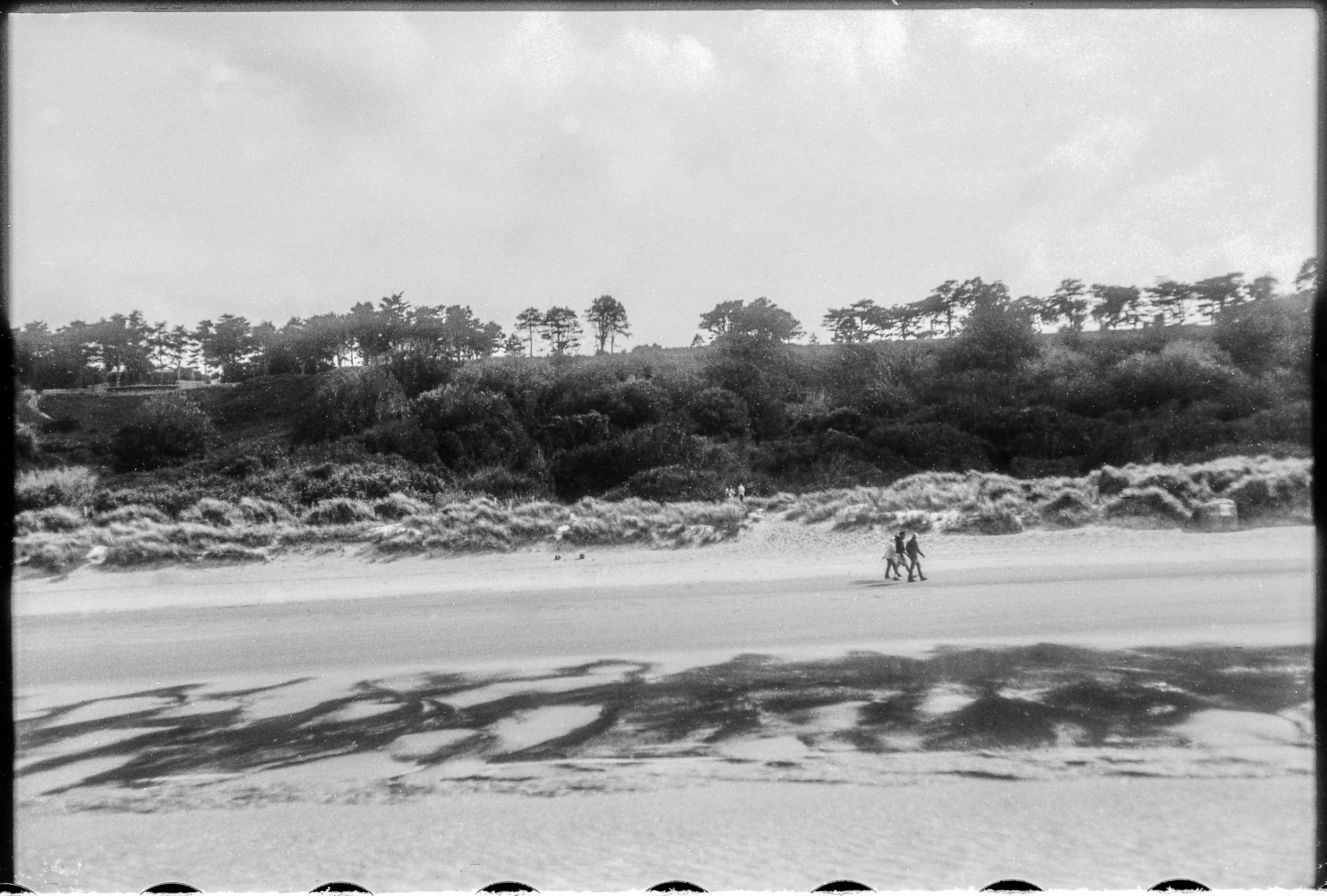
Easy Red sector, Omaha Beach, Normandy, France. A frame exposed on MO-1925 on Omaha Beach, June 6, 2026, processed and dried at room temperature. The film was hung lengthwise to dry.
It’s a photograph taken from the water at the Easy Red sector of Omaha Beach on the 82nd Anniversary of D-Day.
It’s a photograph taken more specifically on the second sand bar at Easy Red. The middle grey strip is the sandy beach. The people are walking near the high water mark where the sand is most firm. The berm with vegetation beyond that was known as the shingle where soldiers sought shelter from German guns on those bluffs beyond. You can distinguish my boots and camera bag on the beach near the center of the picture.
The horizontal darker strip just below the beach is the first runnel, which is a body of water running parallel to the shoreline, water located between sandbars.
The light grey below that at the bottom of the frame is the first sandbar.
I’m standing on the second sandbar just past the second runnel, which is not in the picture. I’m photographing with the same model and vintage 35-millimeter rangefinder camera with 50-millimeter lens that Capa used, a Contax II with a Carl Zeiss Sonnar f/2.0 lens.
I’m standing roughly 100 yards away from my boots.
The people on the beach are quite clearly distinguishable and much larger than in Capa’s pictures.

That the people on the beach in Capa’s photo are smaller means that Capa was further out than I was, further than 100 yards, standing on the bow of an LCVP that was grounded on a sandbar. This would have been either the second, or possibly the third sandbar. This is more consistent with an arrival at 7:50 than 8:20 a.m.
What else?
The sprocket holes seen at the bottom of both pictures is consistent with the mismatch between the proprietary film cartridge and the aperture of the film gate, as pointed out by Allan Coleman and Rob McElroy. [1],[2] This pattern was common in the Contax I, II and III cameras, as well as in other brands, such as Leica. This clearly is not due to an emulsion slide as first proposed by Richard Whelan. [3]
Coleman was quite critical of others who have mentioned the emulsion slide explanation. When ICP Curator Cynthia Young referred to her collaboration with Richard Whelan regarding the emulsion slide, Coleman accused her of plagiarism, called her explanation “fanciful” and said, “Either Young does not understand basic physics and the mechanics of the 35mm camera and film or she takes her readers for fools.” [4] Coleman referred to the idea of emulsion melting and sliding as “mindless, uninformed, misleading blather.” He accused Imaging Resource of going “off the deep end with an elaboration of the received version of the emulsion tale.” Coleman argued vociferously that the emulsion—if it had melted and slid, which he feels is impossible—would have slid directly down and along the length of the film strip with gravity but not laterally toward the sprocket holes.
I offer this picture of a frame showing emulsion slide.
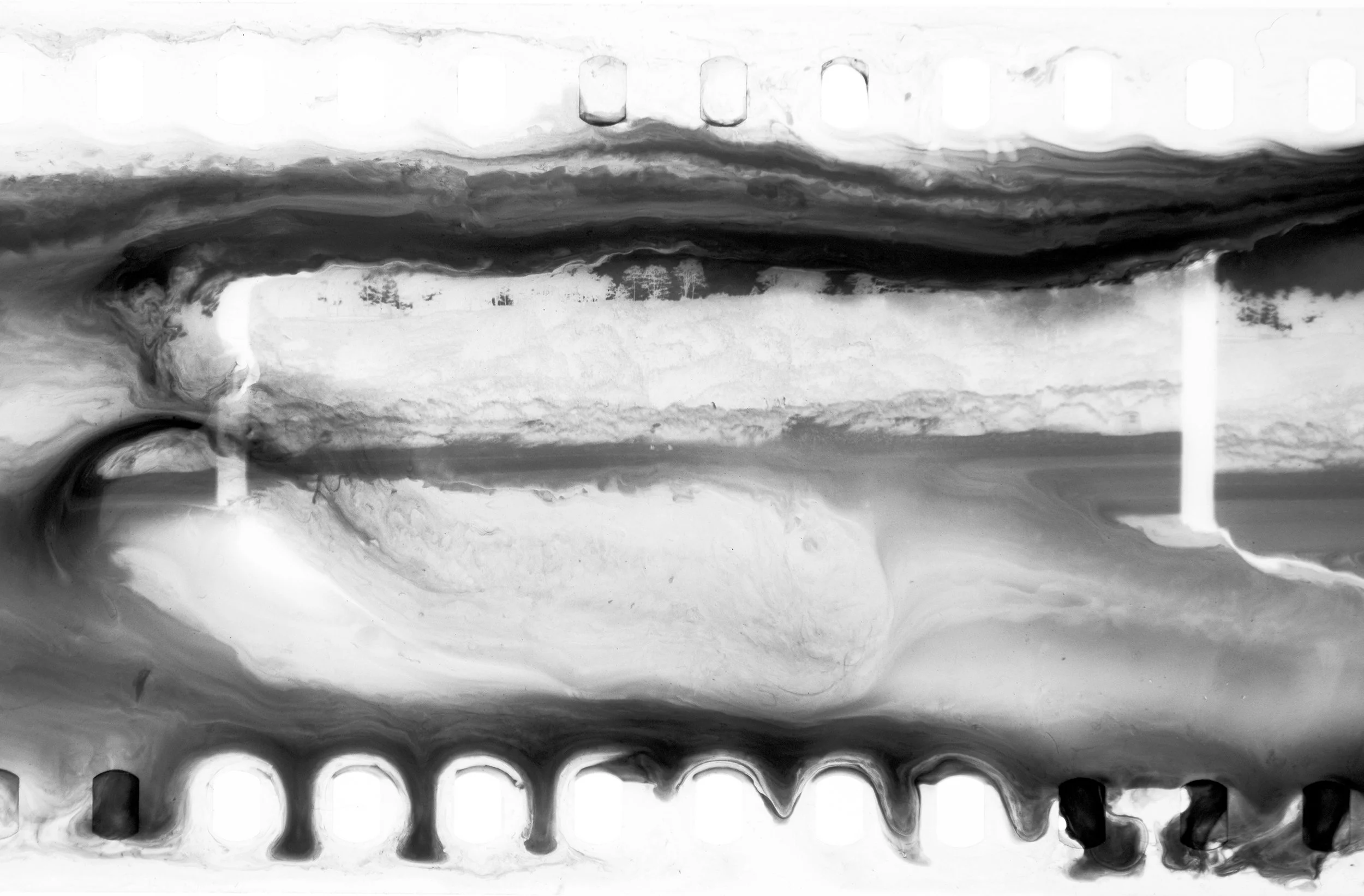
A frame of film exposed on MO-1925 on Omaha Beach, June 6, 2026, processed and dried in a heated drying cabinet. The film was hung lengthwise to dry. Note the lateral extrusion of emulsion between the sprocket holes. MO-1925 does not contain added hardeners to prevent melting and scratching.
I am not suggesting that the sprocket holes seen on Capa’s negatives are from the emulsion sliding. It shows that emulsions can slide when hydrated and heated, and the emulsion can move laterally at right angles to the pull of gravity due to differential viscosities determined by the microclimates around the film.
Both of the above observations support Robert Capa and John Morris’ original story of what happened to Capa’s D-Day photographs.
[Ed. 7/1/26 to add a caption.]
[1] https://www.nearbycafe.com/artandphoto/photocritic/2014/10/26/alternate-history-robert-capa-on-d-day-15/
[2] https://www.nearbycafe.com/artandphoto/photocritic/2015/05/17/guest-post-16-rob-mcelroy-on-robert-capa-2-a/
[3] Whelan, Richard. This is War! Robert Capa at Work. Steidl.
[4] https://www.nearbycafe.com/artandphoto/photocritic/2014/06/12/alternate-history-robert-capa-on-d-day-2/