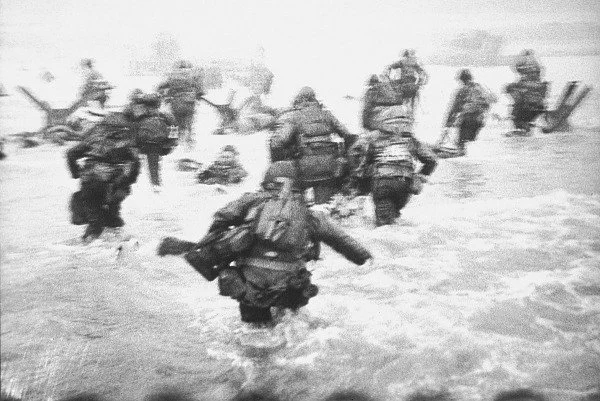
Charles Herrick considers Capa's photographs fraudulent and downright crappy. He stated that Capa used a "trick" on D-Day to dramatize the bland scene he encountered at his late arrival, to support his lie that he arrived early under fire.
Herrick claims that Capa intentionally blurred the pictures to impart this sense of chaos, pandemonium and death. Capa used the trick to fake his perseverance, intentionally adding to the Capa mystique. Herrick says that the pictures are "misleading," and that "the rational mind must realize that it's being misled."
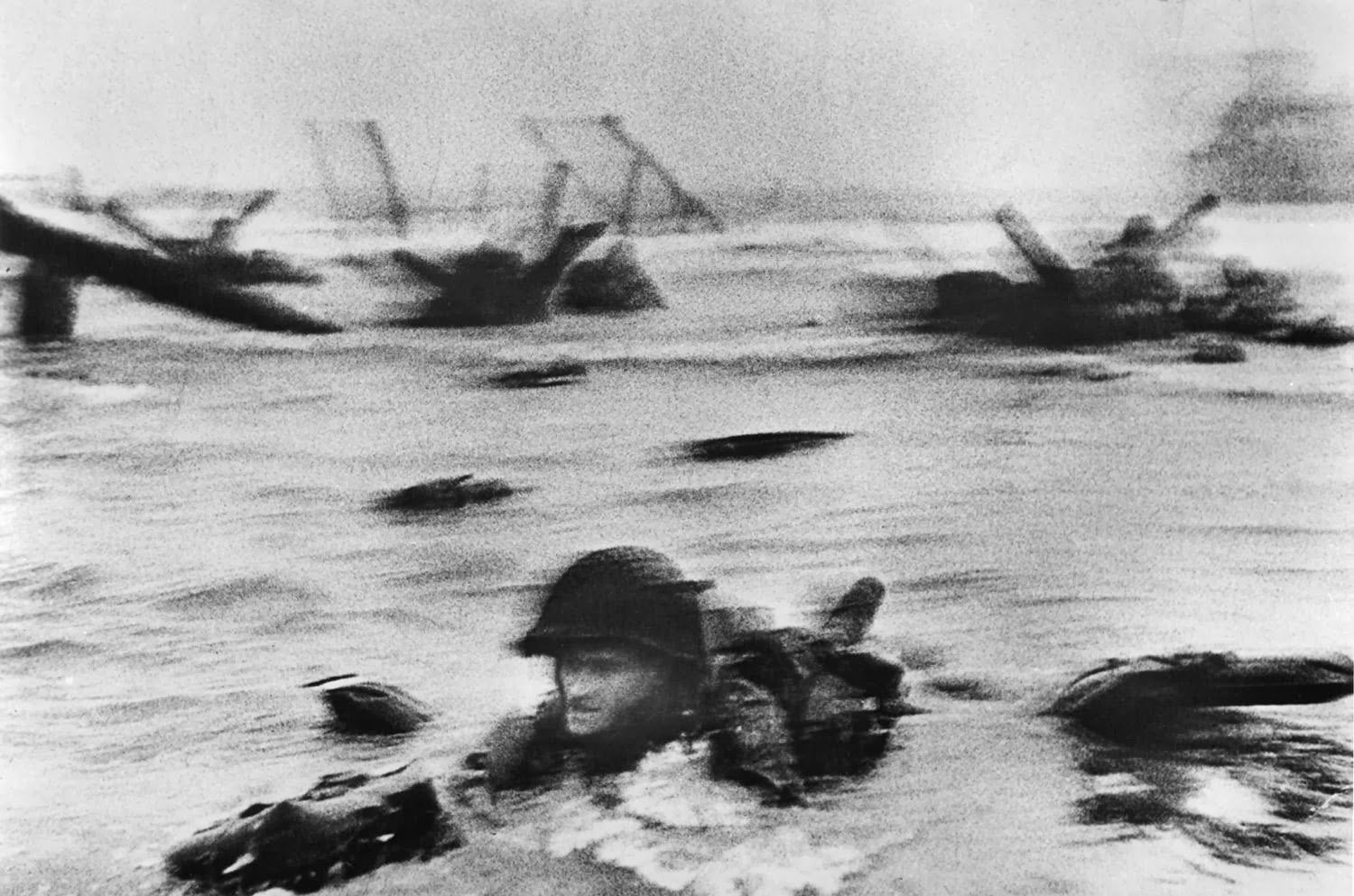
Herrick is so incensed by this "stolen valor," that he devoted an entire chapter* of his book to it, and has mentioned it in multiple interviews. His explanation sounds convincing. But is his assertion correct, or is it another specious argument?
I decided to go back and analyze my photographs from Omaha Beach to find out.

06:41 June 6, 2025. EV 11.5
The D-Day invasion officially commenced at 06:30, which in military parlance is called H Hour. Capa arrived 70 minutes following H Hour, H+70, according to my estimations. Herrick has it at H+130 minutes. Operation Overlord was to commence with the rising tide, for many logistical reasons I will not go into here. This coincided with the twilight of dawn. To understand Capa’s pictures, we need to understand how sunlight changed throughout that morning.
This past June (2025), on Omaha Beach at 06:30, my light meter readings showed an exposure value (EV) of 11.5. It was a cloudless morning with the sun above the horizon, very different than the overcast sky in 1944.
At noon on a cloudless day, the EV would be 15 or 16, a difference of about 4 EV compared to H Hour that I measured. So, the time difference caused an illuminance difference of 4 EV.
Capa’s morning was overcast, as it was for me this year on the day following D-Day. This year, at noon on June 7, the EV was 11.5. Again, if it had been sunny at noon, the EV would have been between 15 and 16, a difference of 4 EV.
But what was the EV when Capa arrived?
Increase in illuminance from the sun is not linear throughout the day, but rather varies with the sine of the sun's altitude, and is influenced by the latitude, atmospheric conditions, and time of year.
The latitude of Omaha Beach is 49 degrees. At this latitude, at this time of year (near the equinox), the altitude of the sun at 08:40 (when Herrick claims Capa was on the beach) is 25 degrees. This results in a clear-sky illumination of 75,000 lux, which is 68% of maximum noon illuminance (110,000 lux at Omaha Beach). So the EV for Capa at 08:40 was 68% of the 11.5 EV at noon on my overcast day, June 7. That approximates an EV of 7.8.
At 07:40 (my estimate of arrival time), the altitude of the sun is 16°, and the clear-sky illuminance is 42,000 lux. That is 38% of noon illuminance, or EV of 4.4.
These exposure values indirectly correlate to the optics and depth-of-field, or hyperfocal distance.
Capa's extant photographs were taken through his Carl Zeiss Jena 50mm f/2.0 Sonnar lens. While nothing in the pictures would be considered sharp by today's digital, high-resolution standards, the pictures show a fairly broad depth-of-field. For example, the men in Negative 32 are about 60 feet from Capa, as I demonstrated in the second blog post, Method.

Negative 32
The men are equally in focus compared to the beach and the trees on the bluffs. In fact, the foam in the water more proximal to Capa is in focus, say at 30 feet and beyond, possibly closer.
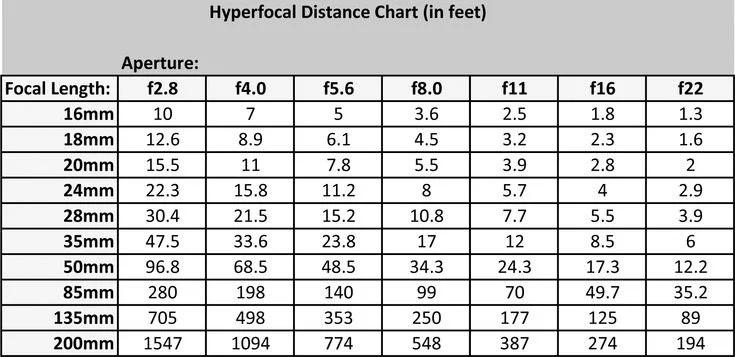
Assuming Capa is a better photographer than Herrick credits, he would have focused his rangefinder patch on the group of men in front of him at 60-plus feet. Using my copy of Capa's lens, and depth-of-field charts, this would have required an aperture of f/5.6 maximum, possibly f/8, in order to have everything in focus from 30 feet to infinity (the bluffs).** This aperture setting was typical for the era.
On D-Day, Capa used Kodak "high-speed" Super-XX film, which had an ASA (ISO) of 100. This is considered slow by today's digital standards. Some camera sensors do not even go that low.

At ASA 100 and aperture of f/5.6, an EV of 7.8 (Herrick’s estimated time of arrival) would yield a shutter speed on his Contax II of 1/10 second, or 1/5 second at f/8. Contact sheets make the negatives look underexposed one stop to my eye. Capa would have shortened his shutter speed knowing that the negatives could be "pushed" during development, making these exposures 1/25 or 1/10 second. Doing so would have reduced the motion blur in the pictures.
The exposure at f/5.6 using my arrival time and pushing the film one stop would be 1/2 second. That's a long time; only a skilled photographer could make a legible image at that speed.
Now that we have a good idea of Capa’s exposure settings, what does this have to do with the blurry pictures?
The general rule of thumb to avoid motion blur in a photograph, provided the photographer is standing steady on solid ground, is to make an exposure that is the inverse of the focal length of the lens. In this case, to avoid blur, the photographer would expose at 1/50 second or faster. But with his lens and film that morning, this would have meant an aperture of f/2, wide open, which is not at all consistent with the depth-of-field apparent in the pictures.
To make his point, Herrick compares Capa’s grainy, blurry pictures to Sargent’s clear image, Into the Jaws of Death. Herrick clearly considers Sargent to be the superior photographer. What he failed to consider, however, is that Capa used a 35mm camera, while Sargent used a 4x5 Graflex, the negative of which is 15 times larger than 35mm. So, it should have 15 times the resolution, and better tonal range. Just another example of incomplete thinking.
Add to the equation the fact that Capa was either standing on the rocking LCVP, or in the ocean with a rising tide and lapping waves, in the middle of combat. Capa made his exposures under extreme circumstances but was forced to use slow shutter speeds, hence the blurry pictures.
Despite all of this, Herrick expects that Capa should have made sharp images, and that their blurriness is only further proof of Capa's mendacity, his "trick" to defraud his viewers and thereby enhance his reputation as the "world's greatest war photographer." To the contrary, this is strong evidence that Capa tried to reduce the blurriness of his pictures.
Herrick admits in multiple places in his book and in podcasts that he is not a photographer, so we can excuse his ignorance of the nuances of illuminance, ASA, and the exposure triangle. But don't you think that he would have been more careful in his analysis prior to publishing it in a book, if his intention was an honest, objective examination of Capa's photographs? Shouldn't he have run this by one of the three professional photographers in the Clan?
Just as the emulsion melt theory doesn’t make sense to a photographer, neither does Herrick’s claim that Capa purposefully blurred his pictures to make him appear more heroic. Frankly, Capa’s pictures are noteworthy for their clarity, given the limitations of his equipment and the adverse circumstances of that morning, and reflect the work of a highly skilled and experienced photographer accustomed to acting decisively in extremis.
To me, Herrick’s illiterate judgement of Capa’s photographic skills appears to be another instance of the Clan’s careless and prejudiced reasoning.
In a future blog post, I’ll discuss my opinion of Capa’s artistic sensibility, which Herrick disdains.
* Herrick, Charles. Back Into Focus. Chapter 16. Casemate Publishers. 2024.
** The aperture influences the optical phenomenon of “circles of confusion,” but this is too confusing to go into detail here. You can easily find an explanation with a quick search, but suffice it to say that it is a measure of the sharpness in front of, and behind, the plane of focus.
If you find this interesting, I strongly suggest you buy and read a copy of Charles Herrick’s book, and read Allan Coleman’s blog posts.
Herrick’s analysis had several different arrival times, so I used 08:40 in the above analysis. His final estimate for Capa’s actual arrival was 08:20. The illuminance at 08:20 would have been 77% of that at 08:40 on a cloudless day, which would have made the shutter speeds one third stop slower.
I asked Grok to calculate the actual illuminance on Omaha Beach at 07:40 and 08:20, on June 6, 1944, considering atmospheric conditions reported by RAF and USAAF weather stations. It determined the illuminance to be 6,500 lux and 10,000 lux respectively. I then asked Grok to calculate the EV at these two values and determine the exposure setting options available to Capa with Kodak Super-XX loaded into his Contax II camera with 50mm f/2.0 Sonnar lens. Grok determined the EV to be 10.7 at 07:40, and that the exposure would be 1/15 second at f/5.6. At 08:20, Grok determined the EV as 11.3, resulting in an exposure of 1/25 second at f/5.6. I was pleased to see this correlated within a stop or two of my calculations, which were based on assumptions rather than actual reported meteorologic data from that day. These shutter speeds still would have resulted in blur consistent with that seen in the above iconic Capa photos. [Ed. note: added 11/24/25]
The above blog post is not intended to establish Capa’s arrival time at Omaha Beach, or to definitively determine the flux of solar illumination while he was there. It is an argument that clearly establishes conditions that morning were bound to produce some blurry pictures. Some of his pictures were clear, and other photographers had clear pictures, which is a tribute to their photographic skills.